


.png)

You know what's strange about estate planning marketing? Most of it completely ignores the actual reason people don't plan.
Attorneys write blog posts about probate. They explain the differences between revocable and irrevocable trusts. They publish guides about tax strategies and asset protection.
And their ideal clients scroll right past it.
Not because it's bad information. Because it's solving a knowledge problem when the real issue is behavioral.
Why People Don't Plan
Research from The Conversation found that most people avoid end-of-life planning not because they don't understand its importance, but because of what they call "misconceptions and avoidance." The study points out something crucial: the process is easier than people think, but perception matters more than reality.
Here's what actually stops people from calling an estate planning attorney:
Death avoidance. Estate planning means acknowledging mortality. It means imagining a world where you're not here. It means thinking about who gets your stuff after you die, which forces you to confront the fact that you will die.
So people procrastinate. They tell themselves "I'll do it next year." They focus on immediate concerns (work, kids, vacation planning) instead of this abstract future event. And they keep scrolling past your blog post about dynasty trusts.
The marketing problem isn't information. It's activation.

The Marketing Content Paradox
Estate planning marketing faces an interesting challenge: the people who need you most are the least likely to engage with your content.
Someone in deep death avoidance won't read your blog post about irrevocable trusts. They'll scroll past your Instagram post about power of attorney. They're not ready.
But here's what most attorneys misunderstand: that doesn't mean the content isn't working.
Marketing isn't just conversion. It's visibility. Trust. Staying top-of-mind. Being the first name someone thinks of when a life event finally breaks through their avoidance.
When someone has a baby, gets divorced, loses a parent, or receives a serious diagnosis - that's when death avoidance cracks. That's when they suddenly think "I need to handle this."
And if they've been seeing your clear, helpful content for months (even if they never clicked before), you're who they call.
This is why consistent educational content matters. Not because it converts procrastinators today but ecause it builds equity that pays off when circumstances change.
What Traditional Legal Marketing Gets Wrong
Most law firm marketing strategies follow a predictable pattern. Branded Agency's guide to law firm SEO outlines the standard approach: optimize for keywords, create content around practice areas, build local authority through backlinks.
All good advice. All necessary for visibility.
But visibility doesn't create action. You can rank number one for "estate planning attorney near me" and still watch people visit your site, read your resources, and leave without booking a consultation.
Why? Because you're treating estate planning like any other legal service. Like it's a rational decision people make when they need information.
It's not. It's an emotional decision people avoid until circumstances force their hand.
The Gap Between Knowing and Doing
Your potential clients already know they need estate planning. They know what happens if they die without a will (the state decides). They know their kids need guardians named. They know their digital assets could disappear.
Knowing isn't the problem. Doing is the problem.
And here's where most estate planning marketing falls short: it keeps adding more information to the "knowing" pile without addressing the "doing" gap.
Think about it. When someone Googles "do I need a living will," they're not really asking for legal information. They're asking for permission to care about this. They're looking for a reason to act now instead of later. They're seeking reassurance that planning won't be as overwhelming as they imagine.
Most attorney websites answer the literal question (yes, here's what a living will does) without addressing the psychological need underneath it.
What Good Estate Planning Content Actually Does
The goal isn't to make someone who's avoiding death suddenly become motivated.
The goal is to be so visible, so helpful, so clearly expert that when their situation shifts - when they CAN'T avoid anymore - you're the obvious choice.
This means your content needs to serve multiple functions:
Building awareness: Your firm shows up consistently in their feed. You post regularly. You're present. Even if they don't engage deeply, they know you exist.
Demonstrating expertise: Your explanations are clear. Your visuals make sense. You understand the confusion families face. This builds trust passively.
Providing shareable resources: When someone IS ready to talk to their spouse about estate planning, they need tools. A conversation guide. A decision framework. Something that makes the discussion feel manageable. Your content gives them that.
Streamlining consultations: For people who DO schedule, your educational content means they arrive informed. You're not explaining POA vs Living Will for the 100th time. You're doing actual planning.
Staying top-of-mind: Marketing is cumulative. Every post, every guide, every resource adds to the impression that you're the estate planning expert in your area.
The person who scrolls past your post today might save it six months from now when their situation shifts. Being helpful over time creates equity. When someone finally decides to act, you're top-of-mind.
The Two-Track Approach
Smart estate planning marketing runs on two parallel tracks:
Track 1: Activation Content (for people who are avoiding)
- Life event trigger lists ("Update your plan when you have a baby, get divorced, move states...")
- Conversation starters ("How to talk to your spouse about estate planning")
- Permission to start small ("3 things you can do today even if you're not ready for full planning")
- Real stories (not fear-mongering, but concrete examples of what happens without planning)
This content addresses the behavioral barriers. It gives people tools to move forward. It makes the first step feel possible.
Track 2: Educational Content (for people who are ready or getting there)
- Visual explanations of concepts (POA vs Living Will, how trusts work, beneficiary designations)
- Process transparency (what happens in a consultation, timeline expectations)
- Specific guidance (when to update, what documents you need, how to choose guardians)
This content demonstrates expertise, builds trust, and makes you visible. It doesn't activate people who aren't ready. But it captures people who ARE ready and makes consultations more efficient.
Most attorneys only do Track 2. They create tons of educational content and wonder why it doesn't convert.
The answer: you need both.
Activation content gets people moving. Educational content makes you the obvious choice when they do.
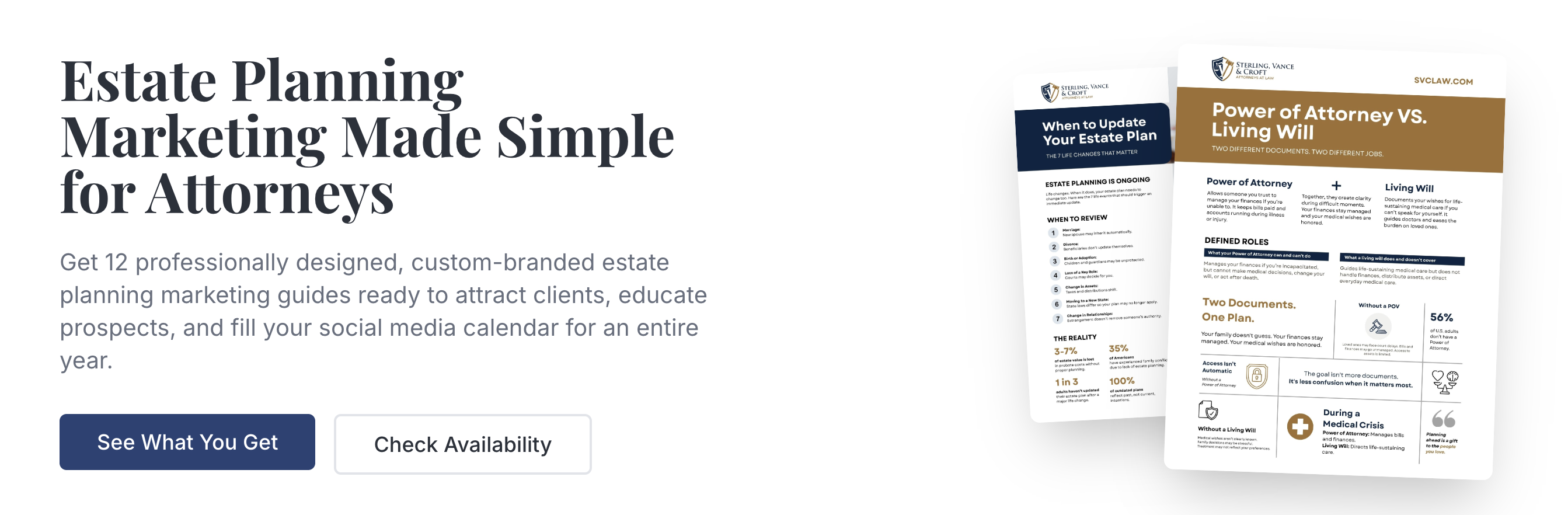
You can see how this works in practice with these estate planning client education tools - they serve both as pre-consultation education AND as ongoing visibility content.
Behavioral Nudges That Actually Move People
If the real barrier is activation, not information, then effective estate planning marketing needs to focus on nudges, not content volume.
What works:
Specificity over abstraction. Don't say "update your estate plan after major life changes." Say "update your estate plan when you have a baby, get divorced, move states, receive an inheritance, or when your kids turn 18." Concrete triggers work better than vague advice.

Social proof that normalizes the behavior. "73% of our clients complete their planning within 30 days of their first consultation" is more effective than listing your credentials. It tells people this is normal, doable, and doesn't drag on forever.
Process transparency that reduces overwhelm. Most people imagine estate planning takes months and requires mountains of paperwork. Show them the actual timeline. Tell them exactly what happens in the first meeting. Make the unknown known.
Reframing that shifts the emotional weight. Instead of "plan for when you die," try "decide what happens to the people and things you love." Same outcome, completely different emotional register.
Quick wins that create momentum. If you offer a free consultation, tell people exactly what they'll walk away with. Even if they don't hire you immediately, giving them something tangible (a list of documents to gather, a family conversation guide, clarity on their next step) creates a sense of progress that often leads to follow-through.
Why Visual Content Matters More Than You Think
Here's something most attorneys underestimate: the way you present information affects whether people share it.
Someone might not be ready to hire an estate planning attorney. But they might forward your clear, visual explanation of power of attorney to their aging parents.
They might send your "When to Update Your Estate Plan" checklist to a friend who just had a baby.
They might bookmark your trust funding guide for "someday when I'm ready."
Every share extends your reach. Every bookmark creates a future touchpoint. Every forward positions you as the expert.
This is why visual estate planning guides often outperform text-heavy blog posts. Not because they convert better immediately. Because they're more shareable, more memorable, and more likely to resurface when someone's situation changes.
What AEO Means For Estate Planning Attorneys
Here's something most legal marketers haven't caught up with yet: people aren't just Googling anymore. They're asking ChatGPT. They're using AI search tools that prioritize conversational, helpful answers over keyword-stuffed content.
Answer Engine Optimization (AEO) changes the game because AI tools don't just return links. They synthesize information and give direct answers. If someone asks an AI "when should I update my will," it pulls from sources that actually answer the question clearly and completely.
This means your content needs to be genuinely useful, not just SEO-optimized. AI tools can detect the difference between "content written to rank" and "content written to help."
What this looks like in practice:
Write for the question behind the question. When someone asks "how much does estate planning cost," they're really asking "can I afford this" and "is this worth prioritizing over other expenses." Address both.
Use natural language, not legal jargon. AI tools prioritize accessible content. If your blog post requires a law degree to understand, it won't get featured in AI-generated answers.
Answer completely in one place. Don't make people click through five pages to get a full answer. AI tools favor comprehensive, standalone resources.
Create decision frameworks, not just information dumps. Help people figure out what applies to their situation. "Do you have minor children? Then you need X. Do you own property in multiple states? Then you need Y."
The Content Estate Planning Clients Actually Need
If you accept that marketing serves dual purposes - building trust over time while clients decide AND streamlining consultations when they're ready - then your content strategy becomes clearer.
You need both activation tools and educational resources.
Activation tools:
Conversation starters. Give people the exact words to use when talking to family about estate planning. Most people don't know how to bring this up. They need scripts.
Decision trees. Help people figure out what they actually need based on their situation. "If this, then that" is more useful than comprehensive overviews.
Worst-case scenarios (done thoughtfully). People respond to stories. Not fear-mongering, but real examples of what happens when families don't plan. Specificity cuts through avoidance better than abstract warnings.
Permission to start small. If someone feels like they need a complete estate plan or nothing, they'll choose nothing. Tell them what the minimum viable plan looks like. Let them take a first step that feels manageable.
Educational resources:
Visual explanations. Most estate planning concepts make more sense with a diagram than a paragraph. Power of attorney versus living will. How assets transfer with and without a trust. When beneficiary designations override a will. Show it, don't just explain it.
Process guides. What actually happens in a consultation? What documents do people need to bring? How long does planning typically take? Transparency reduces anxiety.
Specific scenarios. Don't write about estate planning in general. Write about estate planning for divorced parents, for blended families, for people with vacation homes, for small business owners. Specificity helps people see themselves in your content.
Regular touchpoints. Consistent posting (even if people don't engage immediately) keeps you visible. When circumstances change and someone needs you, you're already a familiar presence.
This is why tools like these estate planning content packages work for attorneys - they provide consistent visibility content (building brand awareness over time) AND pre-consultation education (making meetings more efficient when clients do reach out). You're not choosing between activation and education. You're doing both, strategically, understanding that different content serves different purposes at different stages.
What This Means For Your Marketing Strategy
If you're an estate planning attorney trying to get more clients, here's the reality: your biggest competitor isn't the firm down the street. It's inertia.
People will choose to do nothing before they choose to work with you or your competitor. That's the battle.
Which means effective marketing has to do more than make you visible. It has to make action feel possible while simultaneously building the trust and familiarity that makes you the obvious choice when action happens.
Some of that comes from better content. Content that addresses psychological barriers, not just information gaps. Content that gives people tools to move forward (conversation guides, checklists, decision frameworks) rather than just more things to read.
Some of it comes from process design. Make it stupidly easy to take the first step. Reduce the friction between "I should do this" and "I'm doing this." Every extra click, every unclear next step, every moment of "I'm not sure what to do now" increases the chance someone disappears back into procrastination.
And some of it comes from understanding that you're not really selling estate planning. You're selling relief from the anxiety of not having it done. You're selling the gift of clarity for their family. You're selling the feeling of being a responsible adult who has their affairs in order.
The legal service is just the mechanism.
Where To Start
If you're rethinking your estate planning marketing, start here:
1. Audit your current content. How much of it addresses death avoidance, overwhelm, and procrastination? How much provides behavioral nudges and activation tools? How much just explains legal concepts? You need both tracks, but most attorneys have 90% explanation and 10% activation. Balance that ratio.
2. Create one piece of activation content. Not educational content. Activation content. A guide to having the estate planning conversation with your spouse. A worksheet for inventorying assets. A trigger checklist of life events that mean "update your plan now." Something immediately useful that demonstrates you understand the real barriers.
3. Look at your intake process. How many steps are there between "I'm interested" and "I have an appointment"? Can you reduce that by half?
4. Test different calls to action. Instead of "schedule a consultation," try "get a free estate planning roadmap for your situation." See what resonates with people who are avoiding but curious.
5. Commit to consistency. Marketing is cumulative. The person who sees your content once won't act. The person who sees it monthly for six months might. Every post, every guide, every resource builds familiarity. When circumstances change, that familiarity becomes trust.
And recognize that this is a long game. The person who reads your blog post today might not call for six months. But if your content helped them think differently about estate planning, if it made the process feel less daunting, if it gave them the tools they needed to finally act, then it worked.
Even if they don't remember where they first learned that a power of attorney and a living will are different things. Even if they can't recall which website explained guardian selection so clearly. Even if they end up working with a different attorney in a different city.
In the end, you're participating in a cultural shift toward better end-of-life planning. The more attorneys who get this right, the more normal it becomes for families to plan ahead.
That's bigger than SEO rankings. But it also happens to be good for business.
Tags
Latest Posts


Frankie, the Ultimate Mom App for Busy Moms and Household OrganizationIf you’ve ever felt like your brain has 47 tabs open — school spirit week, pediatrician appointments, birthday gifts, meal planning, field trips, class parties — you’re not alone.Modern motherhood isn’t just parenting.

Boost your revenue
by up 79%
%20(1).png)

